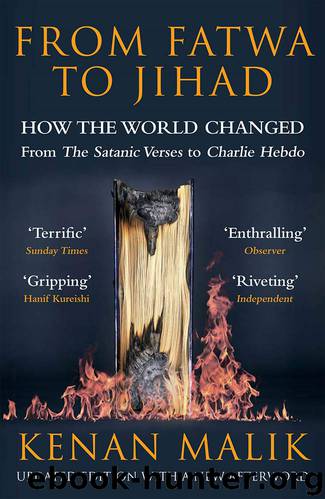
From Fatwa to Jihad: How the World Changed: The Satanic Verses to Charlie Hebdo by Kenan Malik
Author:Kenan Malik
Language: eng
Format: mobi
ISBN: 9780857899132
Publisher: Atlantic Books
Published: 2012-06-07T23:00:00+00:00
3
‘I was going to begin this piece with a quote from The Satanic Verses in which Salman Rushdie satirizes the divine origins of the Qur’an. It was felt, however, that this would be too provocative and insensitive.’ So began an essay I wrote for the Independent in 1994. The newspaper had asked me to write an article about the eighteenth-century English revolutionary Tom Paine. It was the 200th anniversary of his masterpiece, The Age of Reason, a book that was, as I observed, ‘to become The Satanic Verses of its day’. Paine said of his book that it was a ‘march through Christianity with an axe’. Just as his previous major works, Common Sense and The Rights of Man – a defence of American independence and of the French revolution, respectively – laid the axe of reason to the tree of feudal despotism and monarchical corruption, so The Age of Reason laid it to the other prop of national superstition and imposture, the established church. ‘All national institutions of churches,’ wrote Paine, ‘whether Jewish, Christian or Turkish, appear to be no more than human inventions, set up to terrify and enslave mankind, and monopolize power and profit.’
Few authors have so punctured the pretensions of organized religion or so savaged the claims of divine revelation as Paine. Fewer still have faced such ridicule and vilification for doing so. In England The Age of Reason was suppressed for decades and successive publishers imprisoned for blasphemy. Anyone who distributed, read or discussed the book faced prosecution. Some were arrested for simply displaying the portrait of the author. In America, where hitherto Paine had been feted as a hero for his unwavering support for independence, newspapers denounced him as a ‘lying, drunken, brutal infidel’, ‘a lily-livered sinical [sic] rogue’ and ‘a demihuman archbeast’. A century after Paine’s death in 1809, the US president Theodore Roosevelt could still describe him as a ‘filthy little atheist’. Paine, as I observed in my essay, would have approved of Rushdie. And he would have recognized the character of the campaign against him. It seemed natural therefore to link The Age of Reason and The Satanic Verses.
The Independent did not agree. There was consternation in its editorial offices when I filed my piece. Eventually one of the editors phoned me to say that I couldn’t use the quote from The Satanic Verses because it was deemed too offensive and insensitive. No amount of logic or reasoning could persuade her otherwise. The irony of having been commissioned to write an essay on Tom Paine, the greatest freethinker of his age, and then being banned from quoting from a freely available book, seemed to escape the Independent editors. It was, as I observed then, ‘a demonstration of the continuing relevance of Tom Paine to contemporary political discussions’.
These days the idea that we should refrain from giving offence to other cultures seems as incontestable as Rushdie’s ability to attract controversy. Back in 1994 it was still a novel concept. The Rushdie affair was the watershed.
Download
This site does not store any files on its server. We only index and link to content provided by other sites. Please contact the content providers to delete copyright contents if any and email us, we'll remove relevant links or contents immediately.
| Africa | Americas |
| Arctic & Antarctica | Asia |
| Australia & Oceania | Europe |
| Middle East | Russia |
| United States | World |
| Ancient Civilizations | Military |
| Historical Study & Educational Resources |
Room 212 by Kate Stewart(5119)
The Crown by Robert Lacey(4814)
Endurance: Shackleton's Incredible Voyage by Alfred Lansing(4780)
The Iron Duke by The Iron Duke(4354)
The Rape of Nanking by Iris Chang(4211)
Joan of Arc by Mary Gordon(4109)
Killing England by Bill O'Reilly(4001)
Say Nothing by Patrick Radden Keefe(3984)
I'll Give You the Sun by Jandy Nelson(3447)
Shadow of Night by Deborah Harkness(3367)
Hitler's Monsters by Eric Kurlander(3341)
Mary, Queen of Scots, and the Murder of Lord Darnley by Alison Weir(3210)
Blood and Sand by Alex Von Tunzelmann(3203)
Eleanor & Park by Rainbow Rowell(3171)
Darkest Hour by Anthony McCarten(3129)
Margaret Thatcher: The Autobiography by Thatcher Margaret(3082)
Book of Life by Deborah Harkness(2938)
Red Famine: Stalin's War on Ukraine by Anne Applebaum(2932)
The One Memory of Flora Banks by Emily Barr(2863)
